Who Can We Call the Abstract Expressionists in American Art?
Abstract Expressionism was an art movement that arose in the mid-xxth century in America after the end of World War Two. Information technology was said to exist the first explicitly American movement in existence, equally it achieved worldwide prominence and replaced Paris as the focus of the Western fine art world. Abstract Expressionism made utilise of unlike styles and techniques that were often unconventional and unrealistic in order to emphasize the liberty that artists had when conveying their attitudes and emotions.
Tabular array of Contents
- one What Is Abstract Expressionism?
- 2 The Artists Who Formed Abstract Expressionism
- 3 A Suitable Abstruse Expressionism Definition
- 4 Characteristics and Influences of Abstract Expressionism
- 4.1 Influence of World War Two
- iv.2 Which Art Move Was a Major Influence on Abstruse Expressionism?
- 4.iii What Is Action Painting?
- 4.4 What Is Color Field Painting?
- 5 Features of Abstract Expressionism
- 5.1 Motivation for the Motion'south Development
- 5.2 Inspiration from Surrealism
- v.3 Range of Color
- five.4 Size of the Artworks
- five.5 Perspective of the Creative person
- 6 The Lack of Representation Within Abstract Expressionism
- 7 Famous Abstract Expressionist Paintings and Their Artists
- seven.i Mark Rothko (1903 – 1970)
- 7.two Clyfford Still (1904 – 1980)
- 7.three Willem de Kooning (1904 – 1997)
- 7.four Barnett Newman (1905 – 1970)
- 7.5 Norman Lewis (1909 – 1979)
- 7.6 Franz Kline (1910 – 1962)
- vii.7 Jackson Pollock (1912 – 1956)
- 7.8 Helen Frankenthaler (1928 – 2011)
- viii The Legacy of Abstruse Expressionism
What Is Abstract Expressionism?
Developing in New York City, Abstruse Expressionism was a mail service-World War Two fine art movement that came virtually during the 1940s. It was considered to be very important as it was the commencement entirely American fine art movement that e'er existed, as it was created primarily in the United States. Due to its great influence, Abstract Expressionism soon removed Europe every bit the eye of mod art, as New York was of a sudden considered to be the focus of the new fine art world.
While the Abstract Expressionism art motility spread quite rapidly across America, the hub of this style was nonetheless considered to be New York Metropolis and the Californian San Francisco Bay area. Also known as the "New York School", Abstract Expressionism was centered around the importance associated with impulsive movement and expression, with these elements mainly beingness used in the art creation of that time.
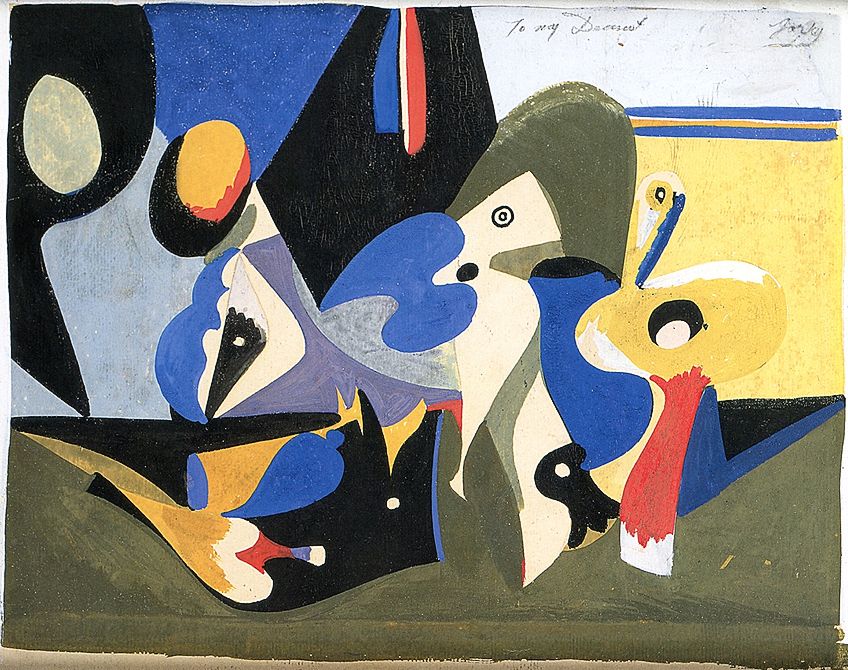 Written report for Painting (1936-1937) past Arshile Gorky;Arshile Gorky, Public domain, via Wikimedia Commons
Even so, the movement was never considered to exist a formal type of association, equally the artists practicing Abstract Expressionism merely shared the same mutual interests that were affiliated with the mode. After witnessing the horrors and brutality of Earth War 2, artists began to insubordinate confronting producing idyllic representations of life.
They felt that traditional art techniques were no longer accurate in capturing an authentic picture of life, as life as they knew it was in complete turmoil after the war ended.
Artists began to explore dissimilar means of expressing emotions and feelings through using abstruse and gestural markings, too as striking colour fields. Instead of depicting figures, artists retreated into the abstract realm, where a new interest in meditation and introspection was adult and reflected in the artworks that were created.
Elements such equally spontaneity and improvisation were highly valued, every bit Abstruse Expressionism artists used their newfound artistic freedom to break abroad from established traditions in both technique and subject matter. Spurred on past this liberation, artists were all of a sudden making enormously scaled works that existed equally observations and representations of their individual mindsets.
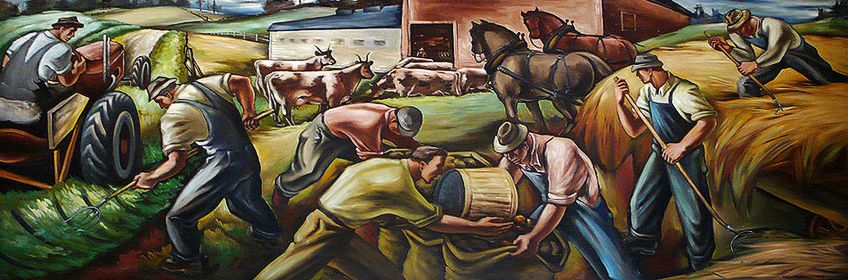 A mural by U.South. Treasury Section of Painting and Sculpture creative person Carl Morris showing agriculture workers, painted in 1942 and installed in 1943;Carl Morris, Public domain, via Wikimedia Commons
In essence, Abstract Expressionist paintings resisted stylistic categorizations, but the artworks could generally be grouped co-ordinate to two basic preferences. The paintings either emphasized lively and spirited gestures or placed a contemplative and more cognitive focus on open fields of colour.
In both instances, the images that were created were mainly abstracted, including the images that were based on truthful visual situations.
The Artists Who Formed Abstract Expressionism
By the belatedly 1940s, multiple factors had shifted into place that allowed for the introduction of a new artistic motility into society. Artist Clyfford All the same has been recognized for launching the movement in the years that followed the stop of the 2d World War, as his artworks demonstrated a noticeable change from representational to huge and abstract works. Jackson Pollock was also seen every bit a pioneer of the motility in 1947, equally the invention of his signature drip technique when painting went on to revolutionize brainchild within fine art.
Willem de Kooning was another influential artist in the development of the movement. His Women series, painted betwixt 1950 and 1953, famously eliminated the elements of composition, arrangement, lite, and relationships to the point where the figures were simply seen as abstractions instead of people.
The most notable prove of group solidarity occurred in 1951 when a group of artists boycotted an exhibition of gimmicky art that was taking place at the Metropolitan Museum. Afterwards, they were coaxed into taking a photo for a magazine and were given the label "The Irascibles". This photo, which gave artists a sense of identity and common objectives, went on to later on popularize the term "Abstruse Expressionism", and thus the movement was solidly established.
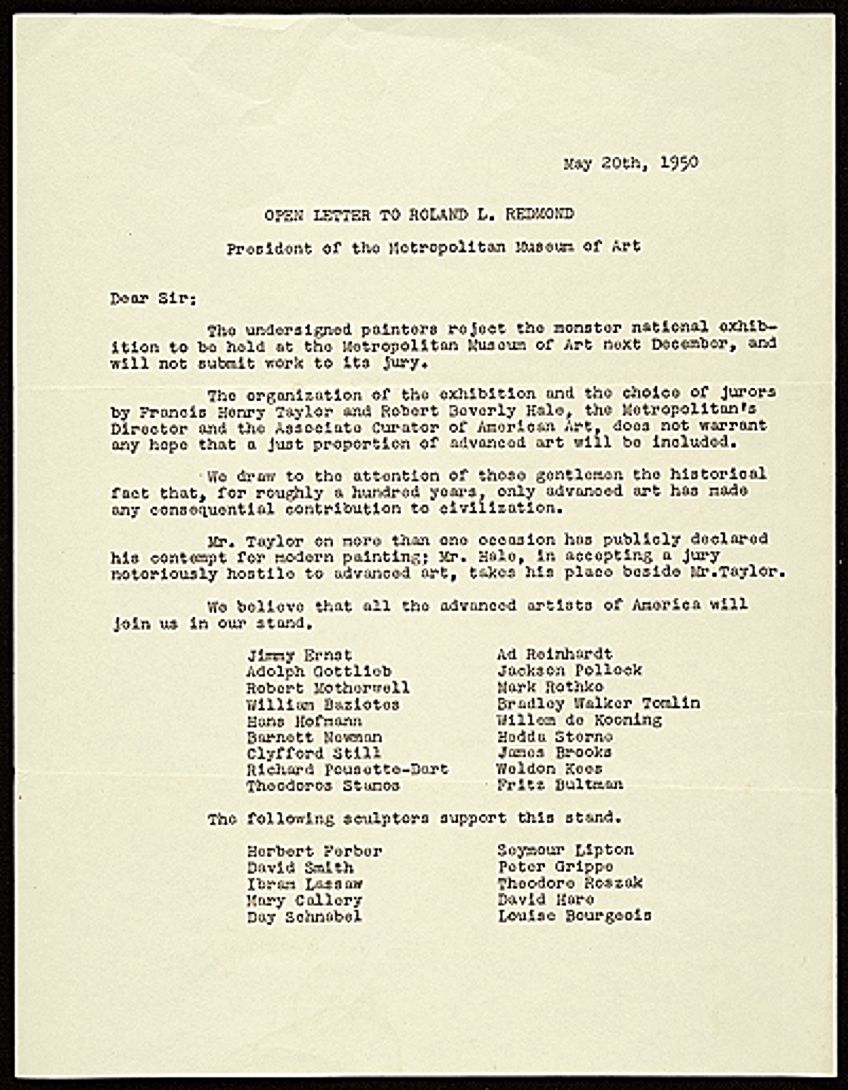 This open up letter appeared on the forepart page of the New York Times of May 22, 1950. The authors titled information technology as an "Open Letter of the alphabet TO ROLAND L. REDMOND" as a means of rejecting the Metropolitan Museum of Art's exhibition;Jimmy Ernst, Adolph Gottlieb, Robert Motherwell, William Baziotes, Hans Hofmann, Barnett Newman, Clyfford Still, Richard Pousette-Dart, Theodore Stamos, Ad Reinhardt, Jackson Pollock, Marking Rothko, Bradley Walker Tomlin, Willem de Kooning, Hedda Sterne, James Brooks, Weldon Kees, Fritz Bultman, Herbert Ferber, David Smith, Ibram Lassaw, Mary Callery, Day Schnabel, Seymour Lipton, Peter Grippe, Theodore Roszak, David Hare, Louise Bourgeois, Public domain, via Wikimedia Commons
A Suitable Abstract Expressionism Definition
The term "Abstract Expressionism" was first used in the High german magazine Der Strum in 1919, regarding the German language Expressionist motility. It was subsequently used to depict American art in 1946 past prominent art critic Robert Coates, who used the term when talking about the paintings of Hans Hofmann, Jackson Pollock, Willem de Kooning, Arshile Gorky, and numerous other artists.
The movement's proper noun was taken from the fusion of the intense emotions and cocky-deprival of the German Expressionists with the nonfigurative aesthetic of movements such as Futurism, Bauhaus, and Constructed Cubism. Abstract Expressionism was considered to be a defiant, lawless, incredibly peculiar, and somewhat nihilistic movement in art, with this term being applied to whatever artists who were mostly working in New York at the fourth dimension that demonstrated vastly different styles in their paintings.
Essentially, an Abstruse Expressionism definition was used to classify artworks that were neither completely abstract nor expressionist in nature. Both types of artworks were still included nether the wide label of Abstract Expressionism due to the styles displayed in the works. This was demonstrated by Jackson Pollock and Willem de Kooning, who created artworks that varied greatly but were notwithstanding seen to be Abstract Expressionism artists.
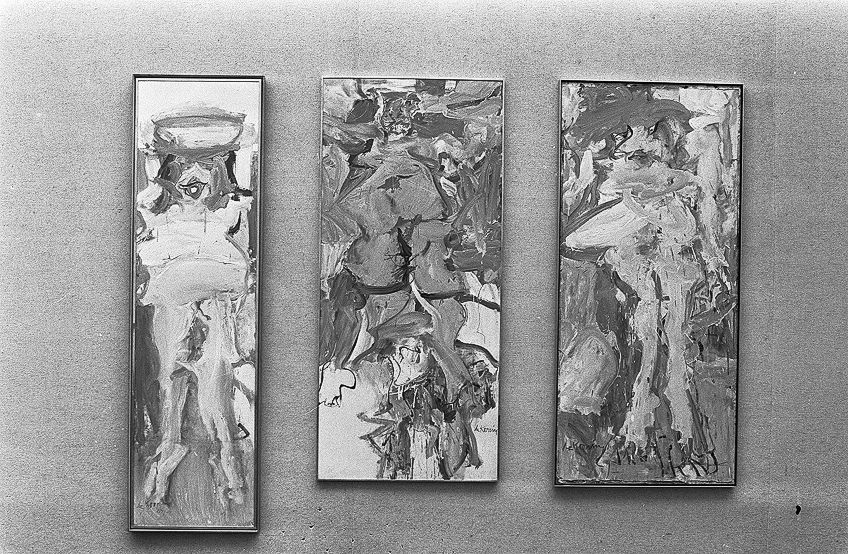 Three Paintings by Willem de Kooning hung together in a kind of triptych, 1968;Anefo, CC0, via Wikimedia Commons
Characteristics and Influences of Abstract Expressionism
A cracking contradiction of Abstract Expressionism was that the roots of the movement really lay within figurative painting, which was popularized throughout the 1930s. These artists all felt the effects of the Great Depression, with their painting styles maturing after existence influenced by both the Social Realism and the Regionalist movements.
Due to these experiences, most of the artists working during that time would later on go on to exist classified as Abstract Expressionists based on the characteristics that were displayed in their artworks.
Afterward Earth War Ii, the resulting political climate did not put up with the social protests that were expressed by artists within Social Realism. Already beginning to ascent during the state of war, Abstruse Expressionism eventually took over as the prevalent fine art movement in America, with artworks existence showcased at different art galleries in New York in the early 1940s. This mail-state of war era was a fourth dimension where art was censored in America, simply every bit the subject matter became more abstruse, art was considered to exist not-political and thus acceptable.
Influence of World State of war Two
During the 1930s and 1940s, many European Modernists began to abscond the onset of the Nazis and escaped to New York to avoid the political upheaval and war that had broken out. Many of the artists who arrived in America brought with them the ideas and practices of European Modernism, with these artists proving to exist invaluable avails to the subsequent artistic developments that would later on occur. An influential artist who did this was Hans Hofmann, who founded the Hans Hofmann School of Fine Arts that trained many prominent artists.
American artists were taught almost the many European artistic techniques, such as the formal inventions of Cubism and the automatism and psychological foundations that upheld Surrealism. The Abstract Expressionists became profoundly impacted by the idea of exploring the unconscious and existential philosophies. Thus, this influx of creative activity within New York meant that American artists slowly became much more knowledgeable about mod European art trends.
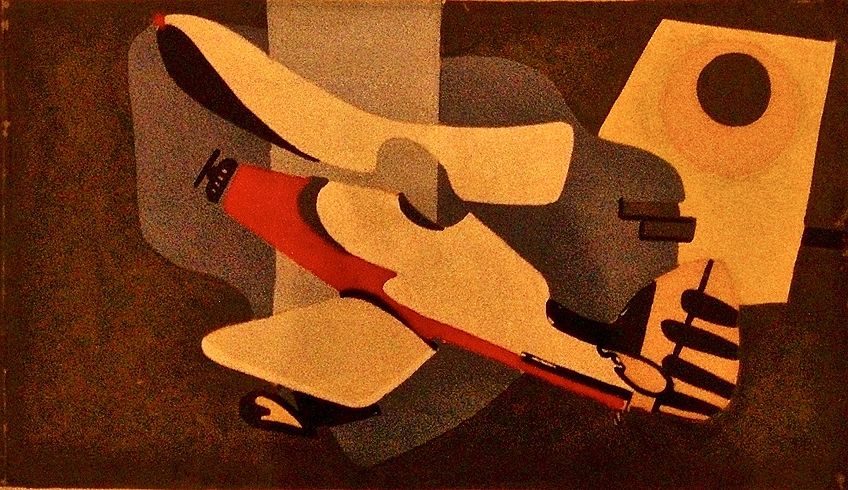 Aviation Limitation of forms under aerodynamic limitations Iv (1935-1936) by Arshile Gorky; Pedro Ribeiro Simões from Lisboa, Portugal, CC BY 2.0, via Wikimedia Commons
Personal encounters with displaced great European artists such as André Breton, Arshile Gorky, Max Ernst, and Salvador Dalí helped to bulldoze away the legendary status acquired by these artists, equally the American artists had initially felt inferior in relation to them. However, the state of war left American artists feeling confident in transcending traditional European influences in art, as they started to develop a rhetoric of painting that was relevant to their own nation.
Soldiers returning home from the state of war had witnessed horrible destruction, genocide, and atrocities that they could not mayhap brainstorm to talk about or understand. Artists who were drafted into the state of war needed an outlet to explore what they had gone through and made use of the expressive emotions and vast abstraction that divers the new art motility.
Abstract Expressionism existed as the appropriate move at the time for artists to describe some of the inhumanity that was experienced.
Artists and other creatives were left to become humble at the evolution of war, even in integrated and cultural areas like New York where free idea and rationalism had always thrived. This paranoia was then represented in the Abstract Expressionist manner that emerged, equally the artworks created fitted in with the post-state of war atmosphere of shock and distress that had gripped order.
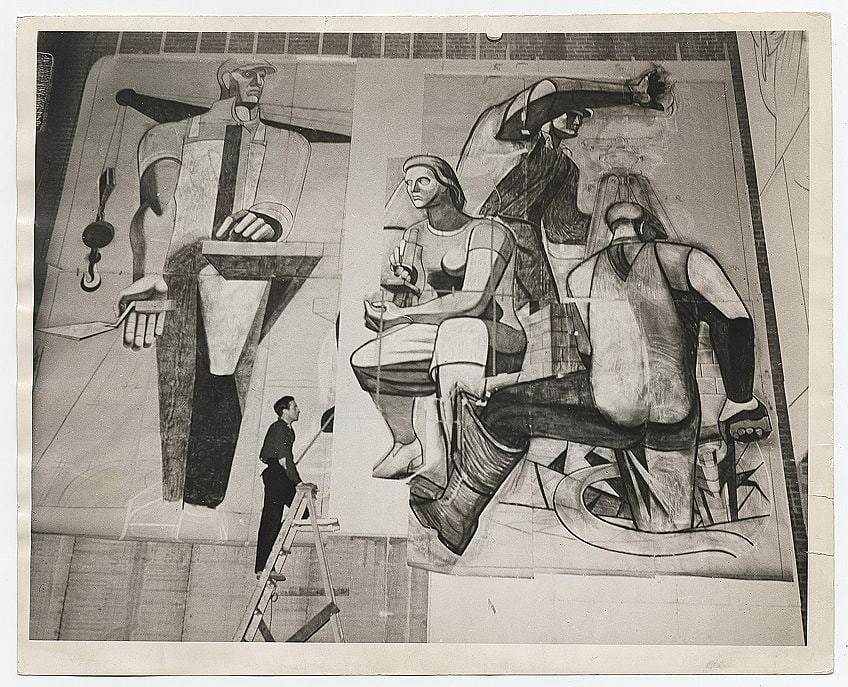 Philip Guston sketching a mural for the WPA Federal Art Project in 1939, photographed by David Robbins;Archives of American Art, Public domain, via Wikimedia Eatables
Thus, American artists made use of the absenteeism that was left by European artists who were defenseless upwardly in the state of war and began to directly the new artistic movement that was to develop. Abstruse Expressionism provided an outlet for artists to convey their feelings and ideas without the worry of a public probing of those thoughts.
Despite this, the public was nevertheless reluctant to accept these Abstract Expressionist paintings every bit true works of art. It was with the assist of forward-thinkers and influential art collectors such every bit Peggy Guggenheim that provided the movement with a wider audience and a sense of authenticity.
This ultimately allowed the motility to evolve into what information technology is known as today, as the careful curation and respect for the artworks of the founding artists of Abstract Expressionism allowed them to even so be in existence today.
Which Art Motility Was a Major Influence on Abstract Expressionism?
An important predecessor of the Abstract Expressionism art movement was Surrealism, which emphasized impulsive, automatic, and unconscious creation. Despite American artists displaying an unease with the blatant Freudian symbolism that was present in the Surrealist movement, they were still inspired by the neat involvement that was shown in the unconscious. Surrealism also centered effectually ideas of primitivism and mythology, with the bear upon that psychiatrist Carl Jung had on recurring motifs being present in Abstract Expressionism.
Before he started experimenting with his iconic baste paintings, Jackson Pollock displayed a great interest in primordial themes, which appeared oft in his earlier works. A notable artwork that Pollock painted in 1943, She-Wolf, was said to exist based on the myth of the metropolis of Rome's birth, which demonstrated the influence that mythology had on his fine art at the fourth dimension. The prominence of mythology and psychological ideas in artworks was likewise displayed by creative person Adolph Gottlieb, who frequently included archetypal symbolism in his paintings.
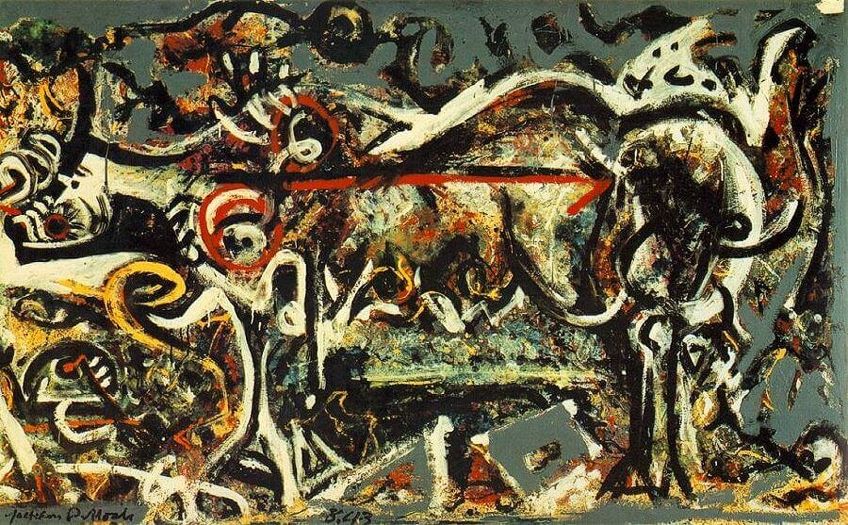 The She-Wolf (1943) by Jackson Pollock; Jackson Pollock, CC BY-SA 4.0, via Wikimedia Commons
What Is Activeness Painting?
Abstract Expressionism tin can be divided into two groups, with the offset grouping being known as Action Painting. This group placed emphasis on the physical activity that was involved when painting. Well-known artists that practiced inside this group of Abstract Expressionism were Willem de Kooning, Jackson Pollock, Franz Kline, and Philip Guston.
One of the near important Action Painting techniques was developed in 1947 and was known every bit drip painting. Jackson Pollock was arguably the most famous creative person who made use of this technique, as he would cascade and drip thinned paint onto an unprimed canvas that he lay flat on the ground.
This was seen as quite radical at the time, equally Pollock abandoned traditional methods of painting in favor of splashing paint onto a canvas in a seemingly chaotic and haphazard way.
The Action painters were more focused on the concrete act of painting as opposed to what they were trying to depict. This process often involved artists splashing and dripping paint onto their canvases, besides as the crude and gestural brushstrokes that appeared from a lack of meticulously applying the paint. Due to these techniques, paintings that were created using the Action Painting style became entirely not-objective and tumultuous.
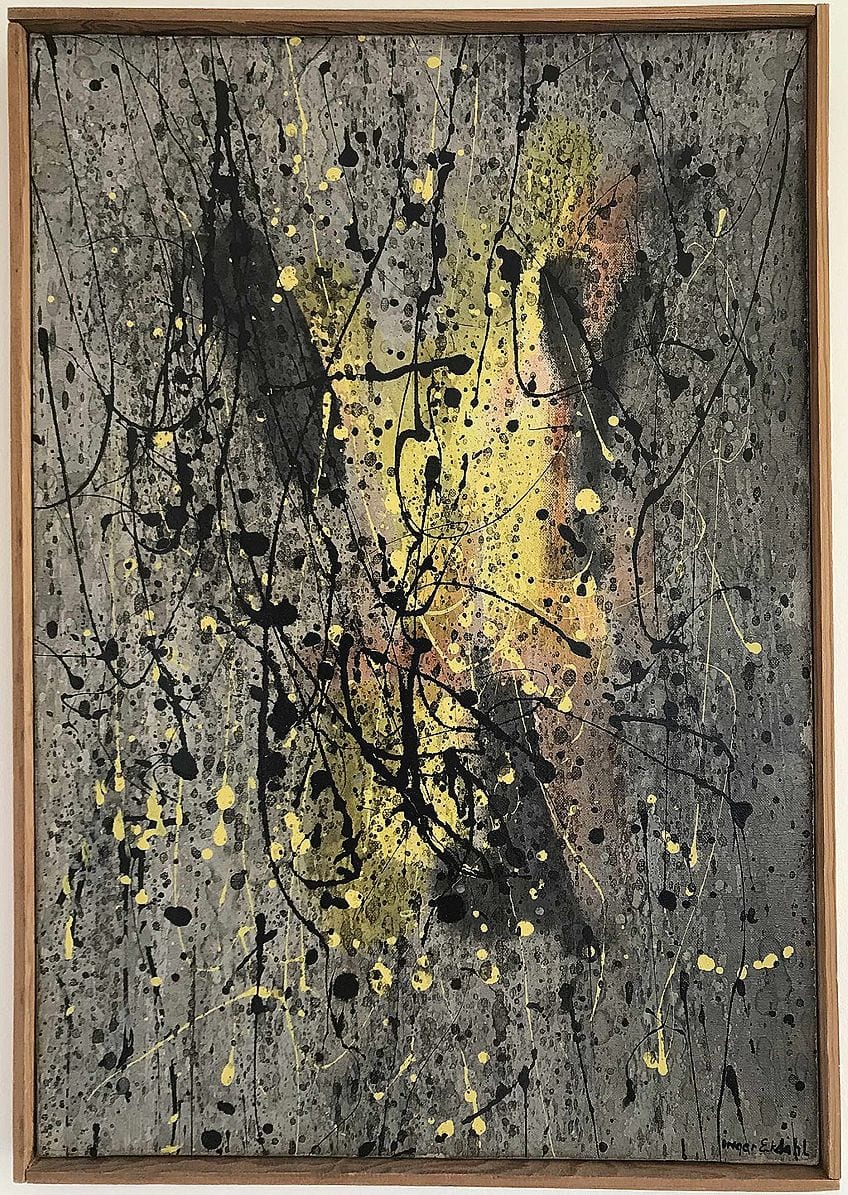 Untitled (1960) past Inger Ekdahl;Artesa2, CC Past-SA 4.0, via Wikimedia Commons
Critic Harold Rosenberg came up with the term "Activeness Painting" in a 1952 article titled The American Action Painters. He stated that the common thread between all Action Painters was that they all understood that painting was merely a physical manifestation of the artwork, as the procedure of making the slice existed every bit the actual piece of work of art. The spontaneity associated with Action Painting was thought to represent the battle artists had with their hidden minds in guild to loosen up so that they could create purer expressions.
Action Painting remained widespread from the 1940s until the kickoff of the 1960s. Additionally, many artists practicing this technique were also said to exist participating in the second group that dominated the Abstract Expressionism movement, with both of these styles being present in the paintings that were created.
What Is Color Field Painting?
The 2d stylistic grouping that dominated during Abstract Expressionism was known as Color Field Painting. This technique was most notably practiced by Marker Rothko and Kenneth Noland in the artworks that they created. Color Field Painting was mainly concerned with exploring the effects that applications of pure color had on a canvas.
The term "Color Field Painting" was beginning used past critic Clement Greenberg in 1955 about the paintings of Clyfford All the same, Barnett Newman, and Marker Rothko. This was because these artists were painting straightforward compositions with large areas of single flat color, which were meant to generate a reflective and meditative response in viewers.
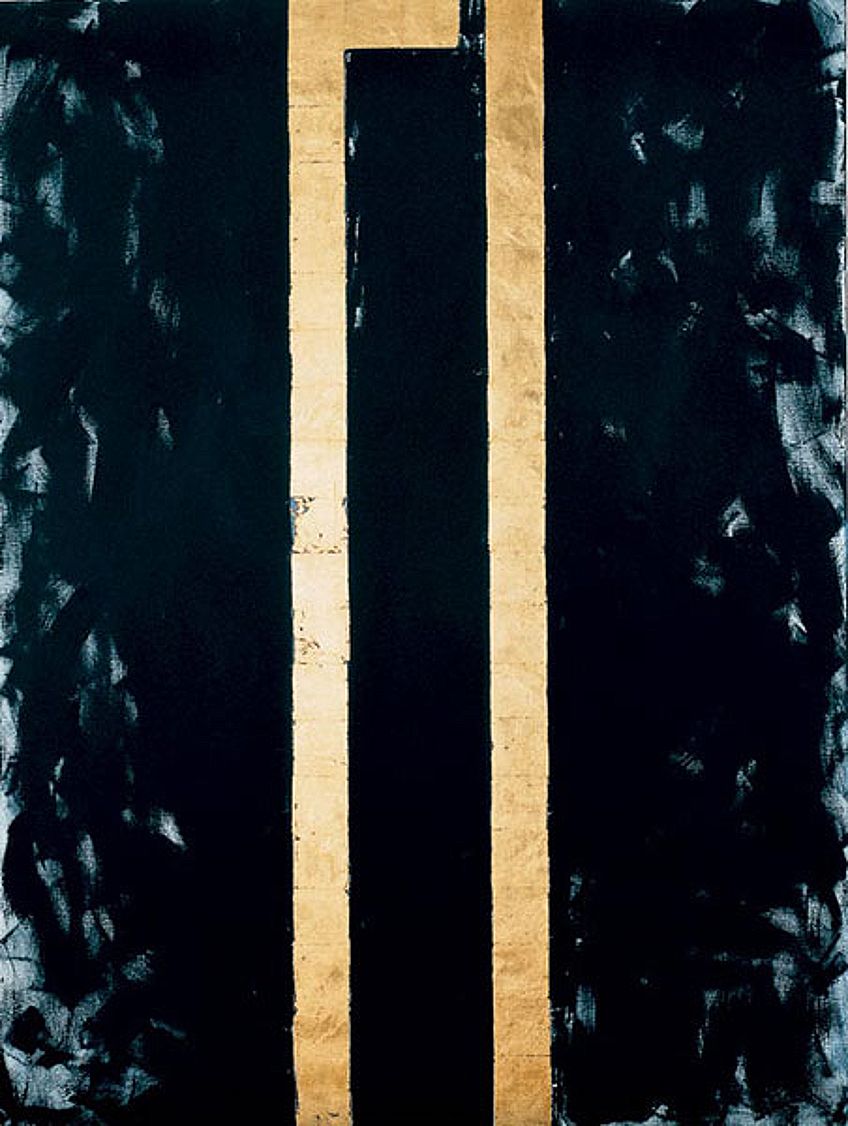 Wasko, Man in the Dark (to Barnett Newman) (1988) past Ryszard Wasko;Ryszard Wasko, CC BY-SA three.0, via Wikimedia Commons
Color Field artists were supposedly looking for transcendence, with their extensive and emotive areas of color immersing viewers and inspiring a class of spiritual musing and powerful feelings. Within these paintings, pictorial means were simplified to focus on and create an elemental impact with the hues of colors used.
Artists stated that their goal was to create paintings that were seen as excellent as opposed to beautiful. Concentration was reduced when it came to accurately depicting subject matter, which freed artists of the outdated traditional styles of painting and allowed them to focus on the implication of colour in their artworks.
Paintings that were produced inside the Color Field Painting fashion aimed to remove the redundant and excessive rhetoric that was present in earlier artworks, with the accent being placed on the visual effects that color had on viewers.
Despite seeming simple, the colors used were typically complex and made up of multiple hues, which added to the depth and sincerity that was present in the artworks of this period.
Features of Abstract Expressionism
Abstract Expressionism was not e'er considered to be a coherent motility, as artists produced works that seemed to be across comparing at times. Due to this, you may exist thinking: What is Abstruse Expressionism so? Substantially, it is an fine art movement in which the artworks that were created all demonstrated specific features that were typical to the general motility. These techniques have been detailed below.
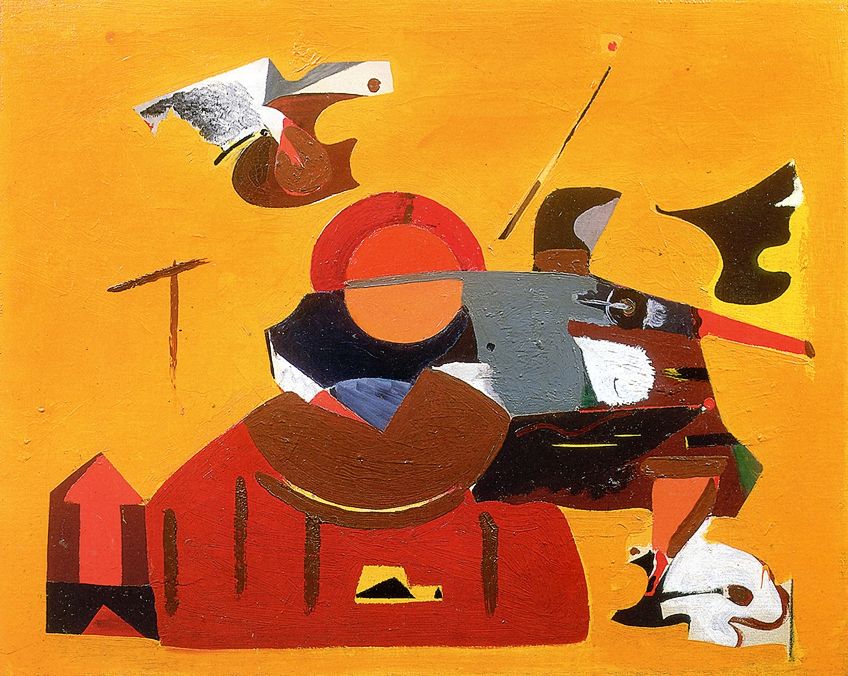 Central Park at Dusk (between 1936 and 1942) by Arshile Gorky;Arshile Gorky, Public domain, via Wikimedia Commons
Motivation for the Motion's Development
The era in which Abstruse Expressionism began was incredibly strained, equally a consequence of World War 2. Artists felt incredibly limited in what they felt was appropriate to depict within their artworks, equally nil seemed authentic anymore. Therefore, Abstruse Expressionism provided artists with a much-needed creative release for their suppressed feelings and thoughts.
Inspiration from Surrealism
When because the electric current movement, it is easy to wonder: Which art movement was a major influence on Abstruse Expressionism? The movement that both preceded and inspired Abstract Expression was the Surrealist movement. The spontaneity and interest surrounding subconscious creation motivated Abstruse Expressionists to follow the flow of their feelings and to encourage the openness of their minds when creating artworks. This approach was utilized in place of start planning out a piece before artists could interpret information technology onto a canvas.
Range of Colour
Abstract Expressionists were able to experiment with brilliant and diverse colors. This was because the artists did non attempt to render tangible and real images of objects or figures. Instead, artists were able to place their focus on the issue that color had within their artworks, as they became fascinated with how colour was able to affect the mood and idea present.
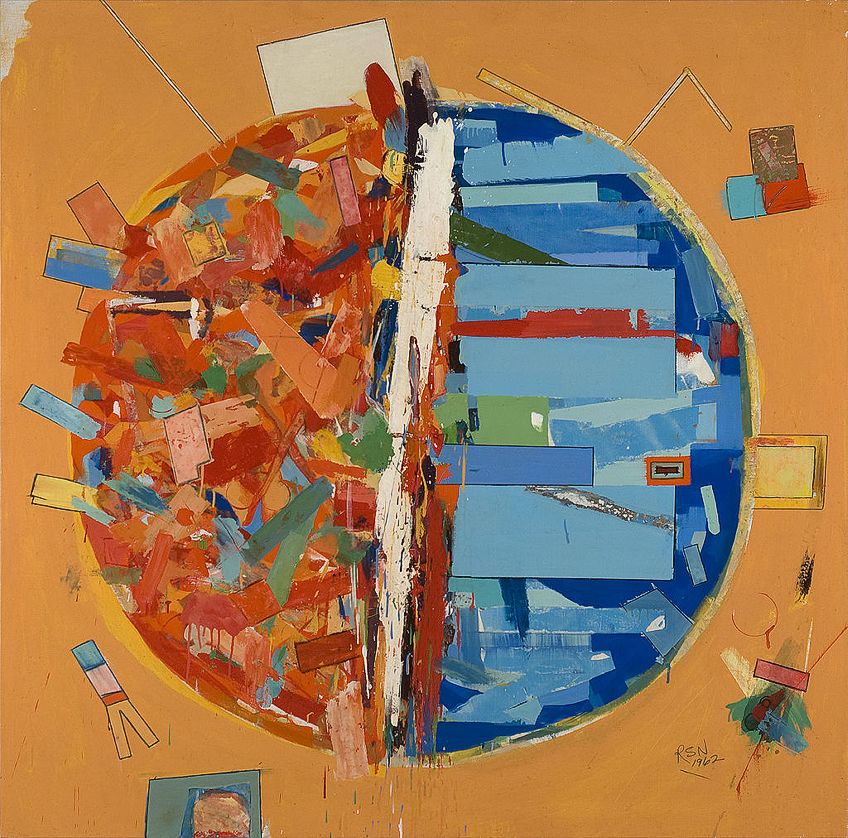 Pedazos del Mundos #6 ('Pieces of the Worlds #half dozen', 1961) by Robert S. Neuman; Ssavage11, CC By-SA 4.0, via Wikimedia Commons
Size of the Artworks
Abstract Expressionist paintings were typically large, with artists choosing to make utilise of enormous canvases on which to paint their artworks. In some cases, artists would fifty-fifty utilize multiple canvases that were meant to exist viewed as one completed work.
Perspective of the Artist
Since Abstract Expressionism was not distinguished by any one specific style, the perspectives and emotions that the artists brought into their artworks were very important. In all of the works produced within this motility, the feeling of the artists and that of the viewers were at the forefront of the paintings, every bit they were more central than the actual epitome that was depicted.
The Lack of Representation Within Abstract Expressionism
During the height of Abstract Expressionism in the 1940s and 1950s, many female painters in New York and San Francisco were as well producing artworks that were in line with the more publicized artworks of their male person counterparts. Despite this, their involvement within the movement was largely excluded from the literature and textbooks that documented the era.
This was because Abstract Expressionism was primarily characterized as a masculine field that was dominated by white males who were cutting through the softer aspects of fine art.
Several female artists were also experimenting with Abstract Expressionism and were creating notable artworks still were consistently forgotten when considering the move. These artists included Helen Frankenthaler, Lee Krasner, Joan Mitchell, and even Elaine de Kooning, wife of Willem de Kooning, to name a few.
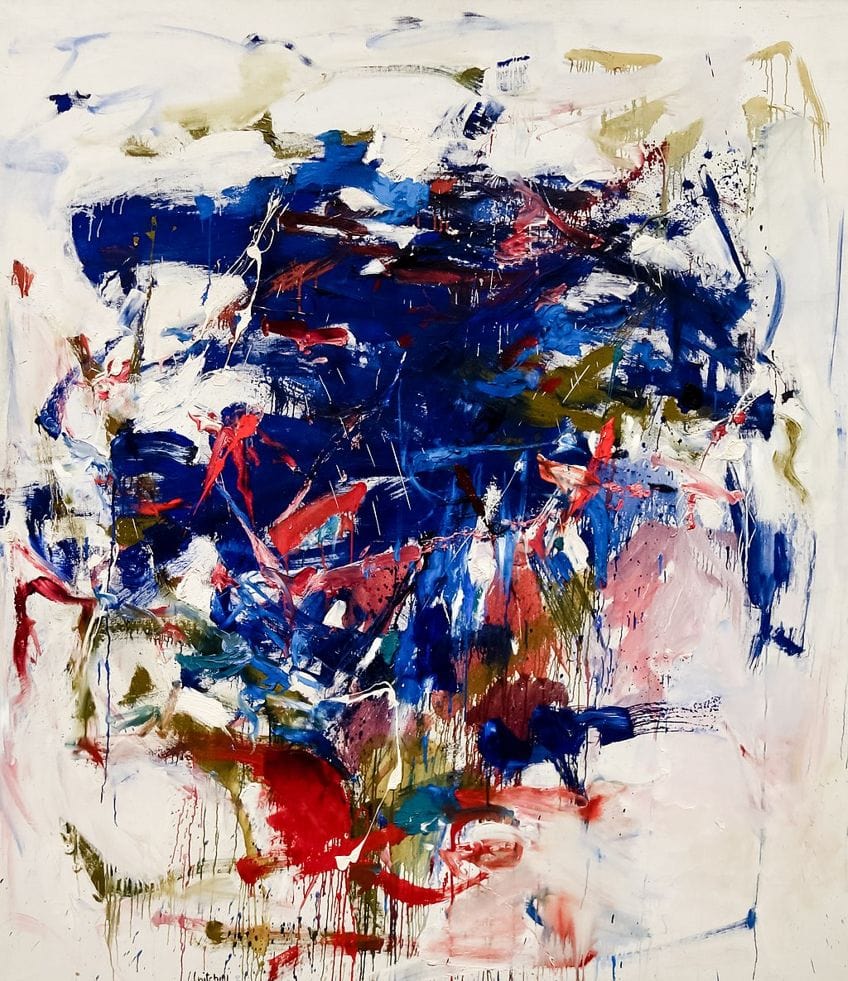 Stone Bottom (1960-1961) by Joan Mitchell;smallcurio from Austin, TX, CC0, via Wikimedia Commons
Similarly, many African American artists who were likewise practicing inside Abstract Expressionism were also left out. Norman Lewis exists as a pregnant example, as his artworks made utilize of many characteristics that were integral to Abstract Expressionism such as vibrant colors and graphic lines. Another notable creative person who went unnoticed due to his race was Ed Clark, who was one of the earliest users of shaped canvases.
In 2016, however, the ladies of Abstract Expressionism finally received their long-awaited recognition when the Denver Fine art Museum put together the traveling Women of Abstract Expressionism exhibition. This exhibition was the first major organized recognition of these women, with over 50 important pieces being displayed.
Famous Abstract Expressionist Paintings and Their Artists
Several of the most influential artists within the Abstract Expressionist movement went on to get some of the most well-known artists throughout history. In this adjacent section, we will explore some of the most notable and instrumental Abstruse Expressionism paintings and artists that came out of the movement.
Mark Rothko (1903 – 1970)
Latvian American artist Mark Rothko was a prominent member of the Abstract Expressionist movement, who was well known for his Color Field Paintings that portrayed misshapen and creative rectangular objects of color. Rothko was mainly known for producing these types of paintings, which he did from 1949 until 1970. His most well-known Color Field Painting is said to be No. 6 (Violet, Green, Red), which he painted in 1951.
In keeping with his other works of that fourth dimension, this painting exemplifies the importance of Rothko's artworks and the prominence of his chosen style within Abstract Expressionism. Each of Rothko'due south Color Field Paintings was titled by their color differences and all consisted of smooth, rectangular bands of color that stretched horizontally across the canvas.
Violet, Green, Carmine exists as a significant instance of the chromatic abstraction that was used by artists within this era, with the accent being placed on the brushstrokes and paint texture as the elements communicate with the viewer.
Rothko'south striking blocks of colour were used to build upward a relationship with the witting minds of viewers, as the bright tones allowed individuals to investigate their own moods according to the color palette.
When painting, Rothko attempted to extract the essence of the colors he used, as each color was selected for a item reason. Additionally, he wrote a series of statements that accompanied his paintings and acted every bit a form of caption.
Clyfford Still (1904 – 1980)
I of the leading figures of the motility was American Abstract Expressionist painter Clyfford However, who was credited with laying the groundwork for the motility. This was because his shift from his previous artistic style to abstraction happened before than other prominent Abstruse Expressionism artists like Jackson Pollock. However, in comparing to his contemporaries, Still was practically unknown for a few years, despite beingness seen as one of the more talented members of the move.
One of Still'due south most well-known works, which he painted in 1957, is 1957-D-No.one. This artwork forms function of the Color Field Painting stylistic group due to Still'due south use of blocks of vibrant colors. 1957-D-No.one demonstrates a noticeable step away from the Color Field Paintings of other artists, as Still incorporates bursts of brilliant and warm colors with fine and wobbly lines, which conjure up ideas of rips and gashes in his painting.
This artwork evokes images of organic shapes and phenomena that remind viewers of Earthly elements such as cavern stalagmites. Through depicting these types of objects, Yet brings the elements that are typically institute beneath the surface of everyday consciousness to life.
Additionally, the color palette that Still uses in this painting plays on the concepts of lite and dark, every bit well equally of life and death, which were ideas that ofttimes popped upward in his other works.
Still's refusal to put his artworks on display in what he accounted to be poor quality exhibitions acquired his reputation to fluctuate despite his paintings gaining creative achievement. Considering of this, about 95% of his art collection was found in his possession when Stills passed away, with some artworks never existence seen past the public earlier.
Willem de Kooning (1904 – 1997)
Another notable leader of the movement was Abstract Expressionist painter Willem de Kooning, who moved from holland to America in 1926. In addition to the artworks he created, de Kooning had a huge impact on the development of Abstract Expressionism, equally he also engaged on social and intellectual levels with other artists working in the movement. One of de Kooning's meaning works created during this time menses was Digging, which he painted in 1950.
Excavation exists as one of de Kooning's about renowned works as it is the most authentic depiction of his Abstruse Expressionist mode, too as beingness his largest painting upward to that date. Within the artwork, nosotros can view multiple forms that are heavily outlined. Upon closer inspection, these forms are actually mere abstractions of familiar shapes that tin exist recognized later on a while, such as birds, fish, eyes, jaws, and teeth.
This artwork demonstrates the expressive brushwork and organization of space that was characteristic in the majority of de Kooning's paintings. Every bit an creative person, de Kooning received creative motivation from many things, with Excavation being inspired past a picture of women working in a rice field from a 1949 Neorealist film.
The tension created between abstraction and figuration is particularly evident in near of de Kooning'southward artworks.
This was thought to be based on his method of painting, whereby he would deliberately scrape, remove, and add paint until he uncovered and rendered exactly what he wanted. Thus, inside Earthworks, the final artwork represents a true excavation of de Kooning'due south mind inside the motility, equally he remains one of the well-nigh gestural Action Painters inside Abstract Expressionism.
Barnett Newman (1905 – 1970)
American artist Barnett Newman was an important member of the Abstract Expressionist move, as he was one of the leading figures of the Color Field Painting group. Newman's paintings were known for their power to express a sense of locality and contingency. Out of his paintings, his best-known piece of work is perchance Vir Heroicus Sublimis, painted between 1950 and 1951. Translated, this means "Man, Heroic and Sublime."
This artwork exists equally one of Newman's largest paintings at the time, despite him going on to create even more than extensive works. Inside the painting, viewers are met with a completely red surface that is broken up twice by two vertical lines, which the creative person termed as "zips". Newman intended for audiences to view his painting from a close vantage bespeak to let the colors to fully enclose viewers.
Newman believed that his vast utilise of such a vibrant color spoke to the inherent chemistry that occurs when two people encounter for the outset time, as the aforementioned intense feelings are stirred when viewing his artwork.
Although the immense size and simplicity of the artwork adds to its importance as an Abstract Expressionist work, the connection that Newman was able to create between the painting and viewers through the use of color is notable.
Norman Lewis (1909 – 1979)
One of the well-nigh important African American painters was Norman Lewis, whose artworks were generally ignored by galleries and museums throughout his career. Despite this, his contribution to Abstruse Expressionism was undeniable.
A contempo retrospective that was held at the Pennsylvania Academy of Fine Arts, along with his inclusion in a massive Abstract Expressionist exhibition in the Uk has begun to reverse his snub within fine art history.
One of his almost significant paintings is Evening Rendezvous, which he painted in 1962. Lewis used his art as a identify for him to escape and to work through the emotionally charged experiences of being a man of color in America. Evening Rendezvous is known for its distinctive apply of cherry-red, white, and blue, with Lewis' color palette indicative of the American flag. The white figures, although very abstracted, are said to conjure up images of hooded Klansmen that are gathered around a fire.
Lewis's artwork was based on the pretense of patriotism that existed in America during that time, which was further demonstrated by the Civil Rights Act that began two years afterward. The background in Evening Rendezvous typifies Lewis' utilise of atmospheric rinses of color to govern the mood he was attempting to create, as is exemplified by the somber mood that exists within this painting.
Franz Kline (1910 – 1962)
The visual language created by American artist Franz Kline in his artworks was dissimilar that of any of his peers, which fabricated him an important influence within Abstract Expressionism. The techniques he used, likewise as his spirited energy when painting, accurately embodied the principles of the movement, which added to his prominence as an Action Painter. One of Kline's notable works from this period, painted in 1950, is Main.
Kline began his career in figuration and oft projected big images of his drawings onto walls when he started painting. After blowing up an image too large 1 day, simply a fraction of the picture appeared in bold and dense black strokes. Kline was so taken aback by the abstraction that was nowadays in this section of the epitome that he began to focus solely on portraying abstract figures and elements in his artworks.
The contrasting black and white sections of Chief have been the subject of speculation for years, as no solid thought seems to be about what object Kline abstracted when creating this artwork. It was believed that the excessive utilize of the color blackness, which appeared often in Kline's other works, was related to his childhood spent in a coal-mining customs.
Using large brushes and household paint to create his works, Kline'southward paintings became well-nigh completely unrecognizable from their original subject.
However, the vibrancy and energy with which he created his compositions seemed to connect them to the titles that Kline gave them, making his paintings prominent examples of Action Paintings. No matter how lively still urgent Kline's paintings appeared to exist, they were always carefully thought out and planned in their implementation.
Jackson Pollock (1912 – 1956)
One of the names most synonymous with the Abstract Expressionist movement was that of American artist Jackson Pollock, who made famous his drip painting technique during his career. Although non the first artist to employ this technique, Pollock was acknowledged as the artist who was able to almost successfully incorporate this technique into his artworks.
Pollock went on to utilize this technique in virtually of his Abstract Expressionist paintings, which are all still well-known today.
Ane of Pollock's significant pieces is his Autumn Rhythm (Number 30) painting, created in 1950. Making employ of the infamous drip technique, Pollock poured and splattered paints from a height onto an unprimed sail that lay on the ground. This process of painting was thought to express his internal emotional turmoil, as Pollock was known for his volatile personality.
This technique, which incorporated gestural lines and textures in his compositions, represented a breakthrough for Pollock and his career. His baste paintings provided the incentive for art critic Harold Rosenberg to money the term "Activity Painting", equally his artworks represented the questionable blend of chance and control, which were equally pregnant concepts inside Abstract Expressionism.
In addition to his erratic process of painting, Pollock stopped giving his paintings evocative titles early in his career. Instead, he began to simply number his paintings, as he considered numbers to exist more neutral. In doing then, Pollock believed that this would let viewers to experience the purity of the painting without referring to a predetermined championship.
Helen Frankenthaler (1928 – 2011)
One of the well-nigh notable female artists in Abstract Expressionism was American artist Helen Frankenthaler, who was introduced to the New York art scene past her friend and fine art critic Clement Greenberg. Frankenthaler spent a summer studying under Hans Hoffmann, fifty-fifty viewing Jackson Pollock'due south debut exhibition, earlier condign an active fellow member of the Abstract Expressionist movement. Frankenthaler'south career lasted over 6 decades, with her beingness ane of the few artists to bridge several generations of Abstract Expressionists.
Her nigh notable artwork, painted in 1952, is Mountains and Sea. This is one of her almost of import works, equally it was one of the first major paintings that she ever executed. In addition to its colossal size, Mountains and Sea reflects Frankenthaler's divergence from traditional mediums and surface and the beginning of her signature technique.
Additionally, this artwork exists equally an important Colour Fields Painting due to the manipulation of colors employed by Frankenthaler.
Instead of treating pigment as a layer that sat on superlative of the sheet, Frankenthaler thinned her oils and acrylics with turpentine to accomplish the consistency of watercolors. Later on placing her unprimed canvas on the flooring, Frankenthaler poured, dripped, sponged, mopped, and rolled the pigment onto the Mountains and Ocean canvas to lightly use her toned-downward washes. The effect that this created was one of strain, every bit the paint completely sunk into the sail and took on a transparent issue.
This process immune Frankenthaler both control and spontaneity inside her artworks, with this combination existing as the central principle of Abstruse Expressionism. Mountains and Sea was inspired by a trip that Frankenthaler took to Nova Scotia, equally demonstrated by the apparent lite and radiance that she accomplished in this artwork.
The Legacy of Abstract Expressionism
Between 1943 and the early 1950s, the first generation of the Abstruse Expressionist movement boomed. After this, it seemed as if the artistic genre had seemingly run its course. This was because the move's biggest achievements were congenital on the conflict between chaos and command that existed in society, which could just be expressed and played out in a variety of ways. Artists such every bit Mark Rothko and Barnett Newman had evolved into such a reductive style that no room for improvement existed, with the style slowly fading out.
This led the way for a new course of art to develop, propelled on by younger artists who were less pressured to produce one exquisite piece of work afterwards the side by side. More homosexual artists, such equally Andy Warhol and Robert Rauschenberg, felt less inclined to follow in the footsteps of such an overtly masculine movement and began to produce art co-ordinate to a new style. This demonstrated the early beginnings of the Minimalist and Pop Fine art movements, which had begun to take over by the 1960s.
The effect that Abstract Expressionism had on fine art was that it shifted the globe'south focus from Europe to America, which helped to make New York into the cultural and artistic hub that it is today. Despite the topics and ideas that informed Abstract Expressionism losing their power to compel the newer generations of artists that were emerging, the legacy and contribution of the movement remain significant.
The Abstract Expressionism art movement was incredibly important within art history, as it introduced America to the remainder of art club that had previously considered Europe to be the only cultural focal point. Artists practicing within this genre experimented with a diversity of techniques introduced by Surrealism, which strayed farther away from traditional art creation. Thus, this movement allowed artists to depict the type of creative freedom in society that was slowly beingness experienced after the horror of World War Two.
Source: https://artincontext.org/abstract-expressionism/
0 Response to "Who Can We Call the Abstract Expressionists in American Art?"
Post a Comment