Cleaner Water Helps Male Fish Again Look and Act Like Men
Some types of h2o pollution can brand male person fish look and act like females. Just a new study shows that better h2o treatment can prevent that. And that could allow fish populations to thrive.
Water treatment plants are supposed to make clean the water from our toilets, showers and sinks earlier releasing it into rivers, lakes and oceans. They are also supposed to treat water from manufacturing plants. But these water-cleanup plants were never designed to remove all pollutants. Most were congenital before anyone realized that hormones and hormone-like chemicals could show upwardly in the water. And such chemicals tin can prove a big problem for fish.

Explainer: Male-female flexibility in animals
How? They can fake out cells of a male's body by sending signals telling those cells that this he fish is actually a she. These feminized guy fish may then have fiddling interest in fertilizing a female's eggs — or he may do and then poorly. The effect: Fewer baby fish. Or at least that's the risk.
Male feminization of fish has been showing upwards in rivers throughout North America.
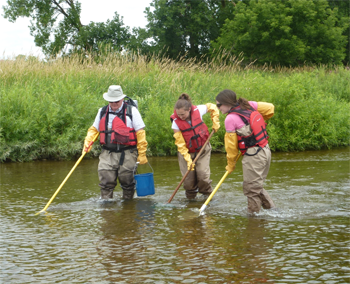
Mark Servos and his team have been monitoring it in Canada's Yard River. Servos is an aquatic toxicologist at the University of Waterloo in Ontario. In that location, he studies the effects of water pollution on rainbow darter fish.
At to the lowest degree once a year from 2007 to 2012, his team caught and examined rainbow darters at a site downstream of a water handling plant. And depending on the year, between 80 and 100 percent of the males had eggs in them. Egg-making is something that only female fish should do. Moreover, those eggs were in the males' testes — reproductive organs that normally make sperm (cells used to fertilize a female's eggs).
Many affected males didn't even look right on the outside. "Male rainbow darter fish are really colorful," Servos says. Or at to the lowest degree they should be. "This color is important for attracting mates." Nevertheless some local males were becoming drab. That could get in hard for them to detect a mate.
Clearly, something was very wrong in these male fish. Until 2013, that is. Suddenly, the number of feminized male person fish started to fall. This happened at the aforementioned time that the local treatment plant changed how it cleaned the water.
The team's information now link these ii observations in a paper published early online in Environmental Science and Applied science.
The trouble with feminized males
The bodies of animals — including humans — use hormones to tell their cells when to switch various activities on or off. Those hormones fit similar keys into "locks" on the outside of a cell. Scientists phone call these locks receptors. When hormones connect with their locks, they affect how an animate being will develop and act. Simply sure pollutants act like fake keys. These hormone mimics are known every bit endocrine (EN-doe-krin) disruptors. They tin turn on or off some normal role of an animals' cells — but at the incorrect fourth dimension. That can make an animal develop or human action in a way that isn't natural.
Explainer: What are endocrine disruptors?
From 2007 to 2012, Servos' team found high levels of endocrine disruptors in the water downstream of the h2o treatment institute. Many of these chemicals mimicked the action of estrogen, a female sexual practice hormone. Some endocrine disruptors came from nascence command pills. Their synthetic hormones left a woman's body in urine. Flushed down the toilet, they ended up at a water-treatment plant. Another common endocrine disruptor is nonylphenol (NON-ul-FEE-nul). It's a breakdown production of certain surfactants. (Surfactants are chemicals that let liquids mix that would not normally do so.) The trouble: Nonylphenol, likewise, can mimic estrogen.
Story continues beneath image
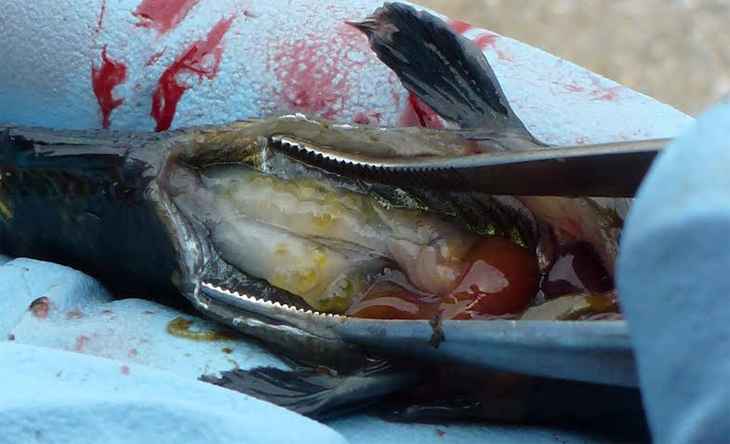
Some male rainbow darters exposed to these pollutants produced eggs in their testes. This took a lot of energy. That reduced the energy available for them to make sperm. Affected fish may take fabricated damaged sperm — or no sperm at all. Eggs laid in the h2o by females won't mature and hatch unless males release sperm to fertilize those eggs. And then egg-making by males could cause fish populations to shrink. Oh, and the eggs made by those males: They're worthless. The bodies of males lack the tubes needed to release those eggs. And so the eggs just collect and have up space in the males' bodies.
Bacteria, bubbling and healthier fish
The good news: Changes to the wastewater-treatment constitute in 2013 led to changes in those males.
The plant had ever used bacteria to break down harmful chemicals in the h2o. Only workers upgraded the arrangement to requite the bacteria more fourth dimension to break downwards chemicals. The establish now too bubbled oxygen into the wastewater. This extra oxygen helped the hard-working leaner grow faster.
Servos and his team tested the water and fish for 3 years after these h2o-cleaning changes. Equally expected, levels of diverse pollutants dropped. These included the estrogen-mimicking chemicals.
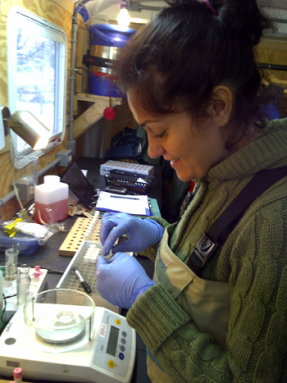
"We don't know exactly how estrogens are reduced," Servos says of the water treatment establish. "The key seems to be giving bacteria more fourth dimension to suspension downwards harmful compounds and to feed them oxygen to speed the process."
And equally levels of these chemicals in the water savage, so did the number of feminized males. Within three years, about all male fish appeared normal again, within and out. The researchers suspect the males' bodies had re-absorbed the useless eggs. The male darters besides regained their rainbow colors.
The study shows that although fish may be exposed to endocrine disruptors early on in life, those changes may not damage them forever. "That was office of the surprise — [that] adult fish could recover," says Servos. He doesn't know whether other species of fish would reply the same mode. He suspects many would.
Chris Metcalfe is an environmental toxicologist at Canada'due south Trent University in Peterborough, Ontario. He studies materials that tin act as poisons in the environs. Metcalfe cautions that not all endocrine disruptors deport the same way. Just because one blazon can be removed from wastewater doesn't mean all others will, too.
He also points out that not all urban areas have practiced water treatment. Some have none; they simply spew polluted wastes direct into rivers. And outside of cities, many people rely on clandestine septic tanks to store water from toilets and showers. Septic tanks filter and capture many pollutants. If people don't take good care of these systems, wastes tin leak from these tanks into groundwater. From there, pollutants can enter downstream rivers, lakes or the sea.
What the new piece of work shows is that hormone mimics can injure fish populations, but that good h2o-cleansing techniques can limit the risk that this happens.
Source: https://www.sciencenewsforstudents.org/article/cleaner-water-helps-male-fish-again-look-and-act-guys
0 Response to "Cleaner Water Helps Male Fish Again Look and Act Like Men"
Post a Comment